Skip to content
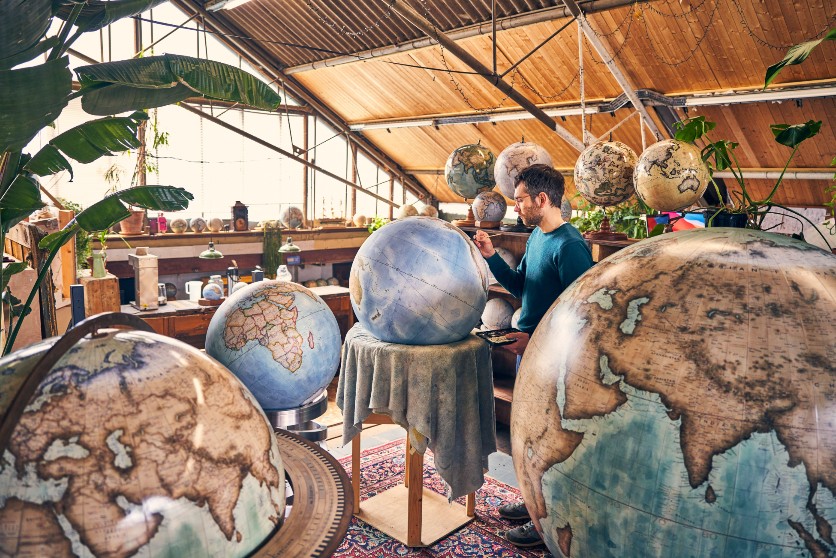
When you first look at the globes in Bellerby & Co’s London studio the first word that comes to mind is magic. Perfect spheres, large and small, at various stages of completion, the oriental rugs on the floor, bright green plants tucked in and onto random corners and nooks. It gives the impression that perhaps this is a wizard’s workshop. Somewhere where arcane knowledge is practiced. Something profound being made. And, maybe that’s not too far off the mark. There is something enchanting and romantic about these special creations and, where a wizard might add an exotic secret ingredient, Bellerby adds a double dose of passion and a unique drive for exacting precision.
He is making the world after all.

A fascinating story and an unexpectedly exciting niche that Bellerby seems to have single handedly brought back to life in the search for the perfect gift. Yes, we’ve all been there, searching for just the right birthday or Christmas present. But when Peter Bellerby decided he wanted to gift his father a beautiful globe for his 80th birthday he came up short on options and began a journey that few would even consider let alone actually do and do well.

Modern globe makers were really letting him down as they were playing it pretty loose and easy with their geographical lines, sometimes just completely covering up some countries all together, and other cartography mistakes that Bellerby simply found unforgiveable. But, how to give his father the perfect globe he deserved? Well, if you want something done right, you’ve got to do it yourself. So, he took up the challenge and in creating the perfect gift he went on a quest that would change his life forever.

One particular challenge he came across was making the actual sphere. Most moulds were uneven or had a flat base somewhere and that just wouldn’t do. A truly professional globe was a work of precision as being just a millimeter off in the build will create much larger imperfections throughout the finishing process. In the end Bellerby relied on Formula 1 fabricators to make their spherical moulds. You could say that Bellerby & Co’s globes are the Ferrari’s of the globe world. Perhaps even more rare.

However, that is just the first step. Then comes cartography and beguiling hand paintings, wood working and metal crafting. It’s a lot for one man and that is why his office has grown to include a dream team of about 32 artisans that brings these jewels to life.
Now they are found in special collections around the world, featured in movies, and even at the U.S. Department of State Headquarters in Washington D.C., where it is known as the Diplomat’s Globe.
We have the opportunity to share a Q&A with Peter Bellerby himself for a look behind the scenes.

How did you first get into globe making and what is the appeal of globes for you?
There were many steppingstones that led to my eventual career as a Globemaker.


And you are working with incredibly fragile paper which you are wetting and stretching – making sure to not overlap, rip, ripple tear or bubble the paper. And at the end all your pieces need to perfectly match up. One fraction of a mm off with one gore (strip of the map) and you will have big issues once you lay that last strip.

Firstly, you need to create a perfect sphere, using two half-moulds. Next, we edit our map, since each globe is made to order we are updating our cartography regularly and personalise depending on our customers preferences. We work with each customer to help them design their globe as they’d like it, this can sometimes be a process over months or even years.
Once the map is ready, it is printed and cut up hand into precise shapes called gores. The gores are painted by hand using watercolors, which give a unique result for each globe. When the gores are dry, they are ready to be attached to the globe, which is called ‘goring the globe’. That stage is very precise work and very difficult because you’re wetting the paper and stretching it, wet paper as you can imagine is very fragile. The paper wants to rip, ripple, bubble or tear naturally. If you work with one piece too long it will naturally degrade After the gores are applied many more layers and detail of watercolour are added and the globe is sealed with either a gloss or matte finish. The globe is then placed into it’s base, often an engraving as well, we make a variety of traditional and modern bases of our own design which are fully handcrafted and stained to the customers preference. Once we are happy with the final outcome and have thoroughly checked the globe over, it is packaged carefully in either a bespoke “flight case” or a special made crate and shipped off to its new home.

What kind of timings are involved for the different sizes of globes?
It takes between a few weeks to 6 months + depending on the size we are working on and the detail of the globe and base. We have spent well over a year before from start to finish working with clients on the more complex commissions in larger sizes.

What particular tools do you need for the task?
The key tools are hands, water, glue.
Going back to the 1400’s the map was etched on to a copper plate and run through a printing press to produce the gores, now we use modern printers. I think etching in reverse onto copper plates would be taking it too far!
Then of course endless tools for working with the metals and woods for the bases.

How accurate are the globes and how do you keep up to date with geographic changes, etc?
It is easy to keep up to date with major changes in the world – and we have 4 full time cartographers and each map is done separate for each customer – so each map is up to date at the time of making.
What skills and personal characteristics do you need to have to be a good globe maker?
Patience, attention to detail, a good eye, capable of working with delicate paper and slow movements.

How do you train your team?
I give them advice but they need to also train their hands which can only be done by trial and error and doing the same movements hundreds of times. Some people will spend months trying and never make a globe to the quality we expect – you can’t train patience or eye for detail – so we have to see someone work and how they tackle challenges and use their hands and help mould them from there.

How do you work with clients to personalize their globes?
We talk them through the process and work one on one via email and phone or in person. We then create mock ups for them to see and feedback on the ideas they had as they take shape on the map.
Can you give us an overview of the costs of your globes?
We create globes from 12cm to 152cm diameter.

Where do your customers come from?
We have been surprised by some of the locations recently in Peru, Greenland, Cambodia, Vietnam, Kyrgyzstan, Uruguay, Nepal +
Most people find us through word of mouth as we do no advertising which is amazing.